I had a goal when I walked up to the synth today: use at least two sub-patches that I haven’t used during this Jamuary. I knew one technique I was going to use off the bat. It had been a while since I did a “pinging QPAS” patch, and it was conducive to the mood I was in. The other manifested as I looked at modDemix. “Ring modulation! Of course!” To me this patch is almost a stereotypical Make Noise Patch™️. It’s the kind of sound that comes so very naturally from a Make Noise synth. The sort of patch that it was made to do.
This patch was made up of two basic parts. Tempi clocked both channels of René which sent out two trigger sequences from the X and Y channels to both inputs on QPAS, using the Low Pass outputs to create a stereo percussive beat. René was being modulated by two sample and hold signals in order to change the Snake of each channel and keep the trigger sequence from repeating itself. QPAS was highly modulated by Wogglebug’s Woggle VCO output, which is the first time I’ve ever use any of Wogglebug’s VCO outputs for any reason. I started this portion of the patch to serve as a percussive base. And although I think this part served that function admirably, it’s hard to describe many of the sounds produced by QPAS as something reminiscent of percussion. Maybe percussion stretched out like putty. Or a DJ scratching a turntable. The audio rate modulation from the Wogglebugs to both Radiate inputs fundamentally changed the sounds to something I very much enjoyed, though it’s quite hard to explain. The Burst outputs from both Wogglebugs also modulated the !!¡¡ inputs, while a fast moving Ramplet signal from Multimod modulated the cutoff frequency. Resonance was set high enough, about 10:30), for fairly lengthy tails on each ping, though, as with any ping from any filter, higher pitched notes were shorter than lower pitched notes. The result is more like the results of a loosely evolving drum circle with funky instrumentation where the only requirement was “stay in time” than a real groove of some type. It’s background noise to create a mood.
There is no real science to this part of the patch. It’s a bunch of triggers to the inputs, and a bunch of high frequency modulation being thrown at about every CV input except Resonance. But it’s also why using Make Noise is often special. One can get deep into the weeds with complicated patching techniques, patch programming, and circuitous routing of both control and program signals. But one need not do that in order to get good results that are fun and unique. Make Noise is one of those modular environments that really takes modulation well. As with anything one can go overboard and really muck a patch up, but generally speaking Make Noise modules tend to take high levels of modulation gracefully.
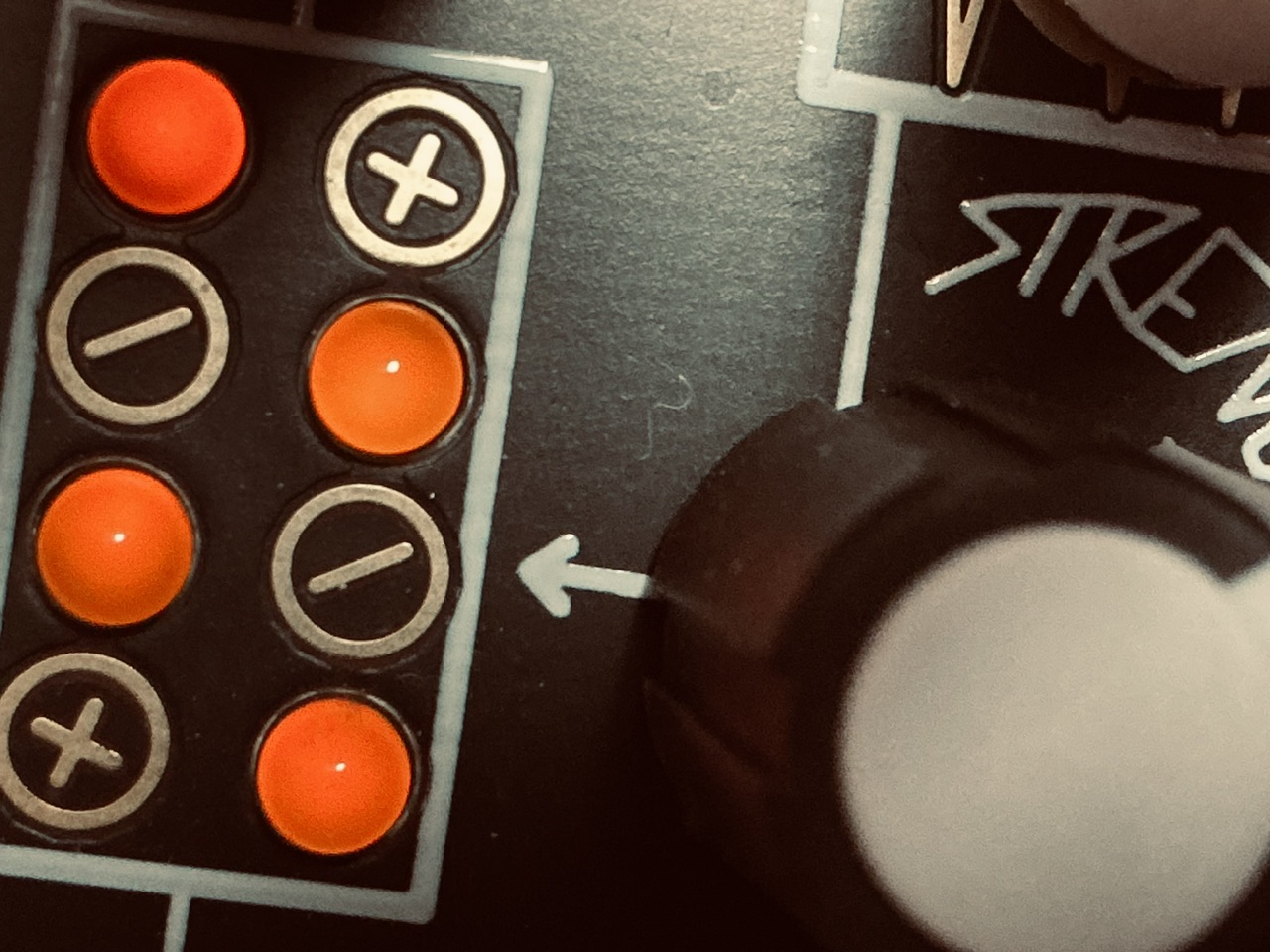
The second voice in this patch was made up of two sine waves from Spectraphon ring modulating each other at a 1:1 frequency ratio (I.e., they were tuned to the same note) in modDemix. Spectraphon was sequenced by 0-Ctrl, with one of its gates reversing direction. Although it’s useful in many respects, I don’t use modDemix very often for any “important” role. I’ll sometimes use it as a simple mixer and a simple VCA with a unipolar envelope or gate, but most often I’ve used it as a simple level attenuator for a too hot signal. Though I do have times when I’ve used it as a ring modulator, those times are few and far between. It’s just not really a sound I use that much (and when I do it’s almost always in a context very close to this patch). But today ring modulation was the point, and I really dig the result. Improvising the gating of the sequence was a kind of fun I don’t normally have when using the modular. It was lots of knob-twisty goodness. That said I had hoped that the short decay envelope from 0-Ctrl would have been shorter. I’m not sure whether it was because of being externally clocked or whether there was an actuator problem, but there just didn’t seem much difference between using the Dynamic Gate and the Dynamic Envelope outputs (which signifies my lack of understanding the Strength Control(s) and how it related to the Speed control, and thus the longer-than-desired envelopes being an actuator issue). These Dynamic Envelope hit a LPG in QMMG. From QMMG, the signal was patched to Bruxa for some light echo and texture. Bruxa, once again, provided a bit of magic to the sound. The ring modulated tones were great on their own, which is why I never overdid the wet/dry mix on Bruxa in this patch, but the bit of added echo and noise to the ring modulated sequence was special.


Modules Used:
Tempi
René Mk2
QPAS
0-Ctrl
Spectraphon
Wogglebug
QMMG
modDemix
Bruxa
Mimeophon
Maths
Multimod
CV Bus Mk2
Maneco Labs Otterley
Performed and recorded in 1 take in AUM on iPad via the Expert Sleepers ES-9.