Made Noise – Sketch 23

When I walked up to the synth today, I only had a vague idea of what I wanted to do. I knew I wanted something reasonably simple sounding (even if the technique isn’t simple at all) and slow moving. I’ve been intently listening to an incredibly well done drone-y album by ambient artist Fields We Found, which inspired me to move back into a particular sound I enjoy intensely, but with a twist.

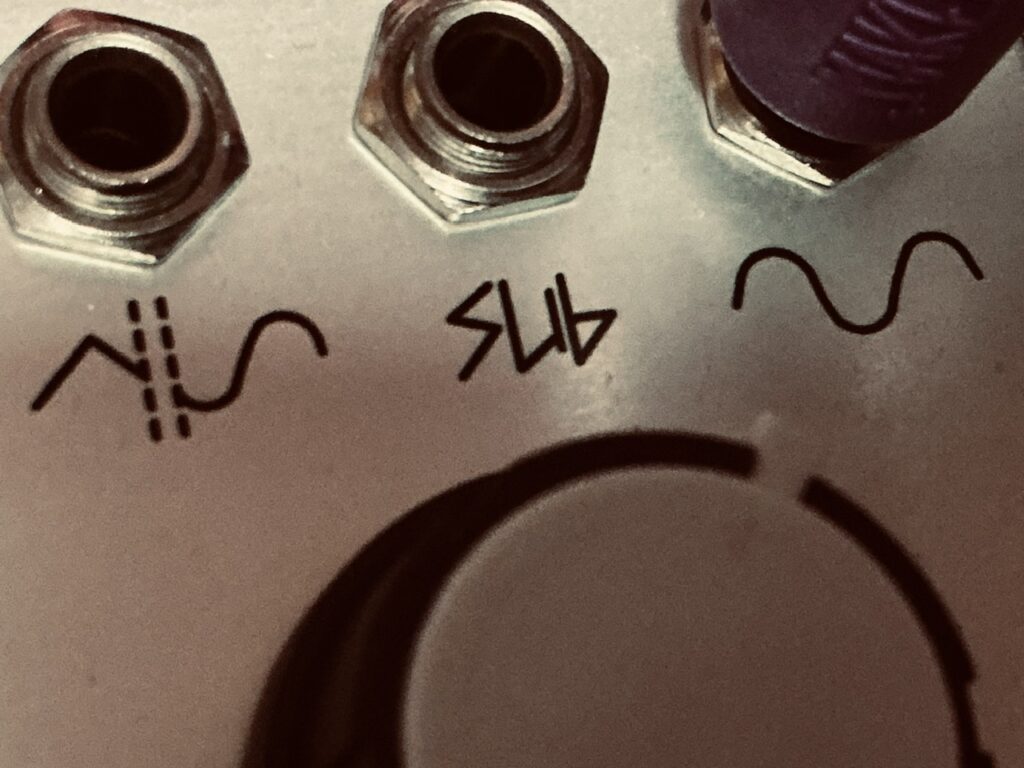
The drone that starts the piece is about as simple a patch as they come. A saw wave from the Sub output of Spectraphon’s Oscillator A through QMMG in LP mode with a high dose of resonance, and the cutoff frequency modulated by an attenuated triangle function from Multimod which produced a throat singing or “Ooooooooohm”-like sound. I never wanted too many harmonics to peak through. Its entire point was to be the foundation of everything, but more of framework off of which everything else might be supported, not a focal point. Everything in this patch was moving, and it needed some kind stability, though not stillness. Despite being the first sound in the piece, this bass drone was the last part to come together. I’ve found that I often compose in the same way I write. An idea will start to materialize, which leads to other ideas. These different ideas get synthesized together (literally!) which lead to yet more ideas for further combining. It can all be quite fluid, but very rarely is it sequential.

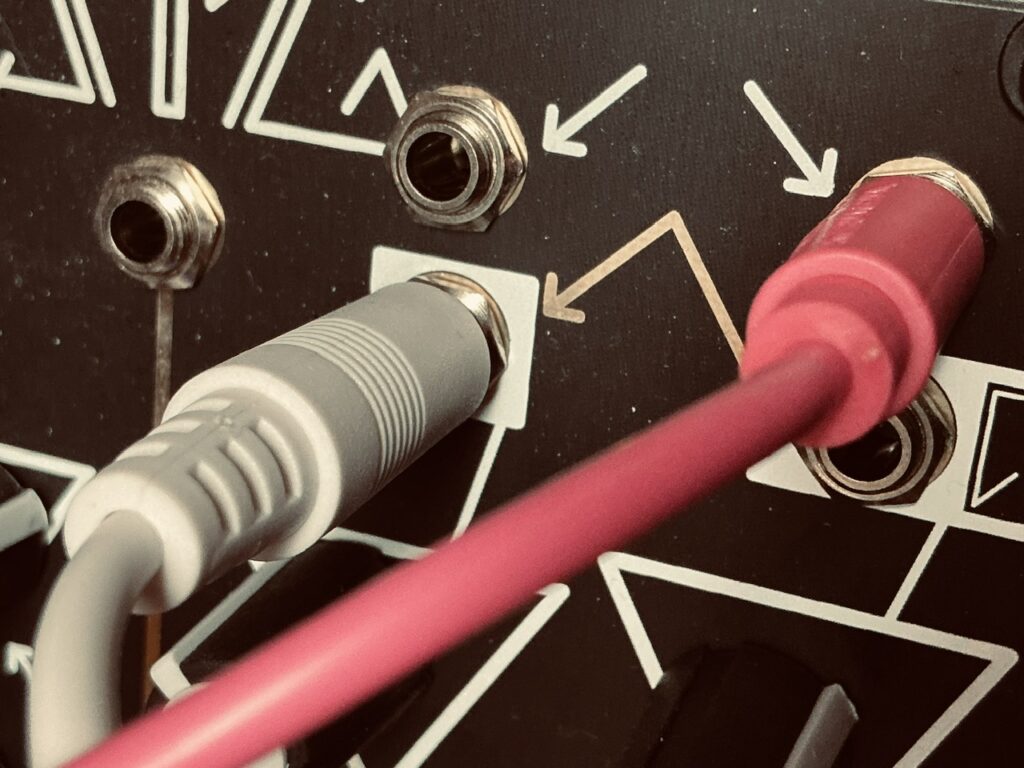
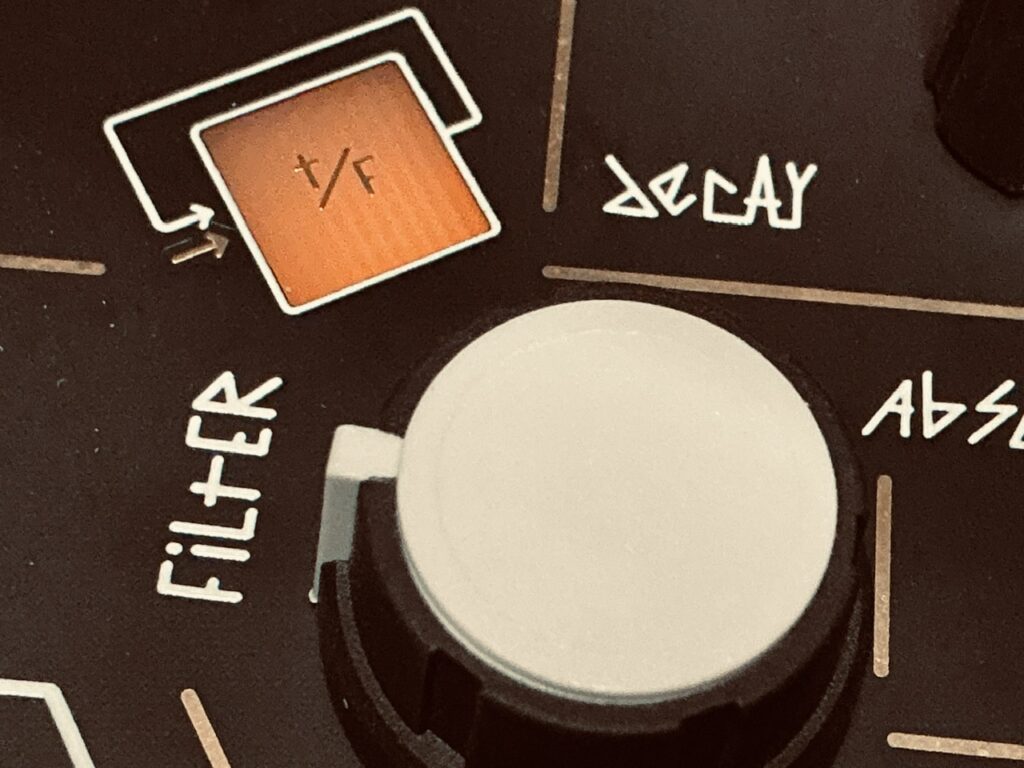
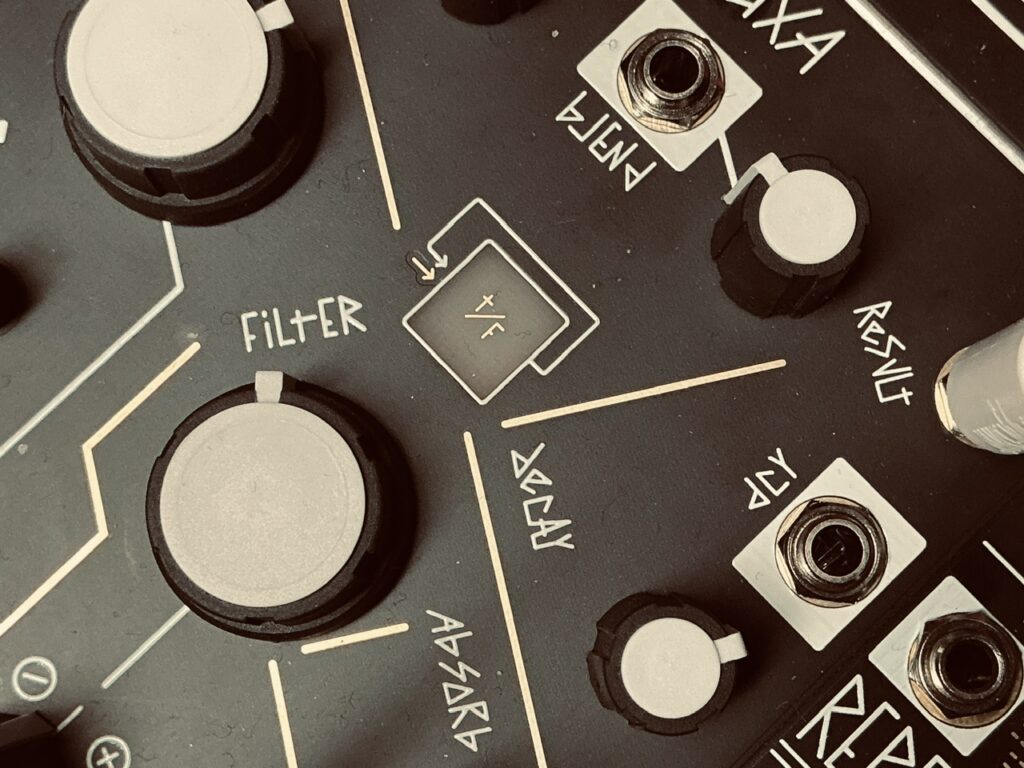
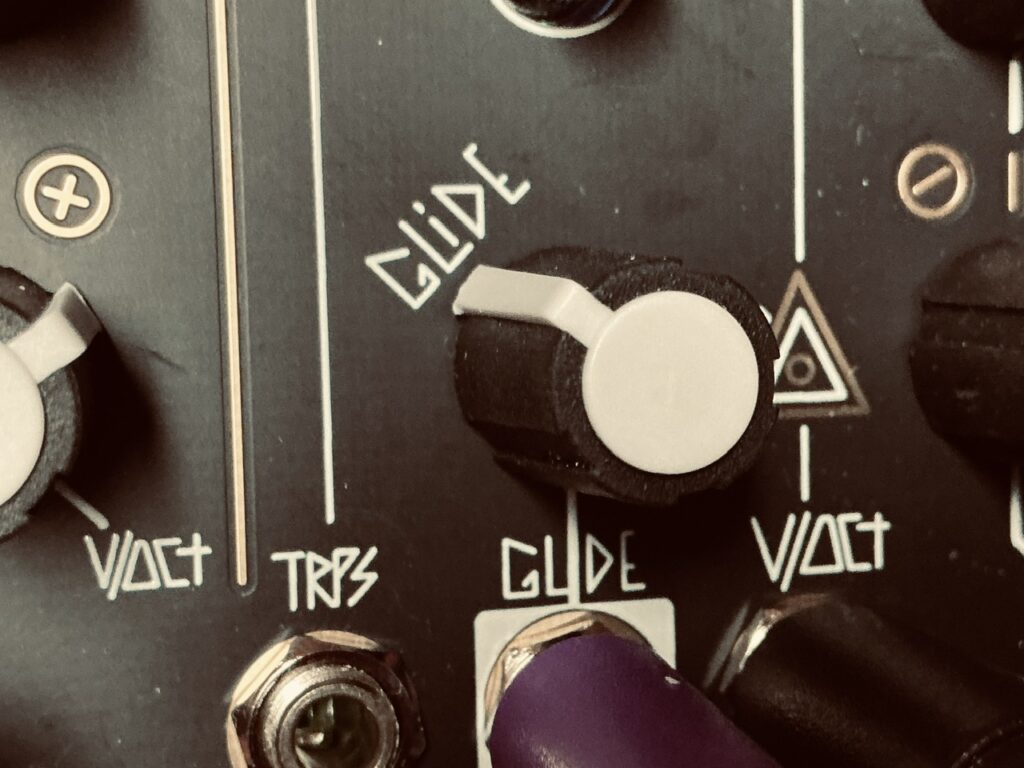
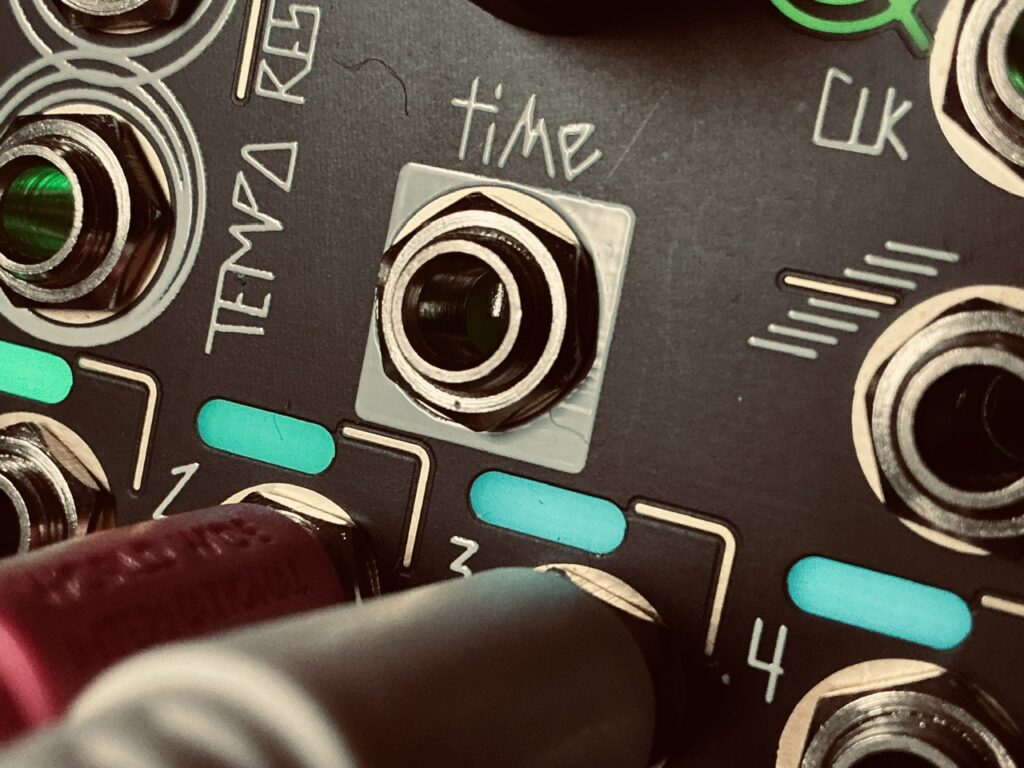
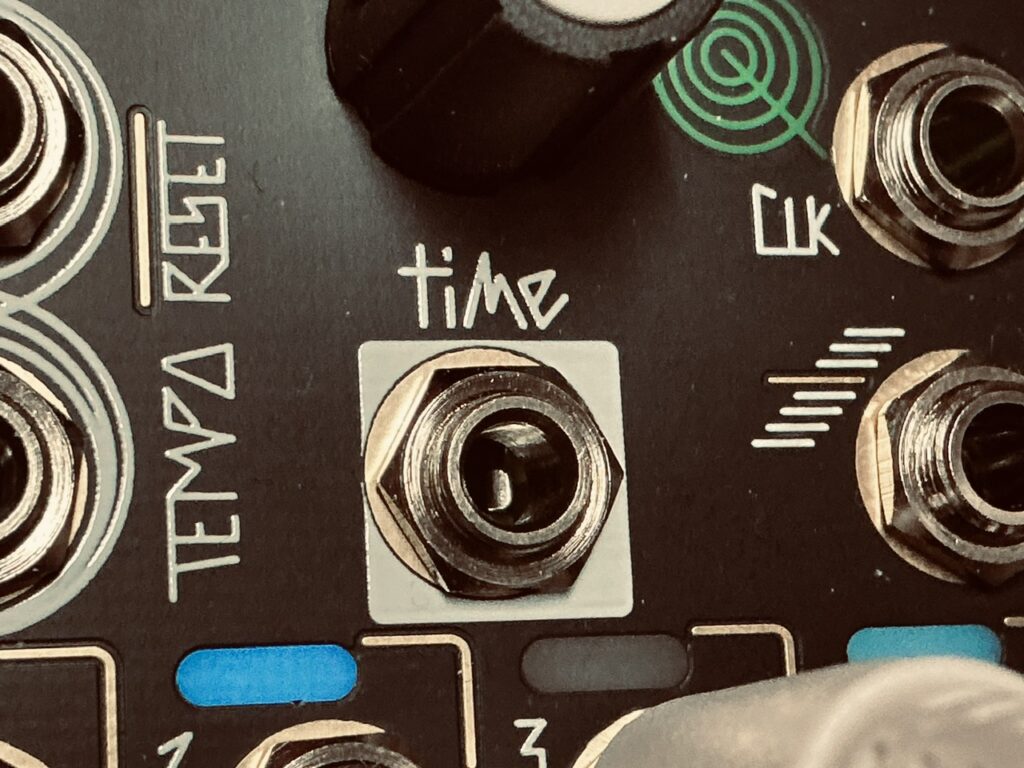
QMMG’s output was patched to the Bruxa for texturization and a bit of growl. It seems that no matter the context of a patch, Bruxa can find a way to fit in. It’s one of those modules. In this patch both Decay and Absorb were modulated by Spread triangle functions from the same Multimod modulating QMMG’s filter cutoff, with a side of patch programming its CV output to Time (the one with the attenuverter).
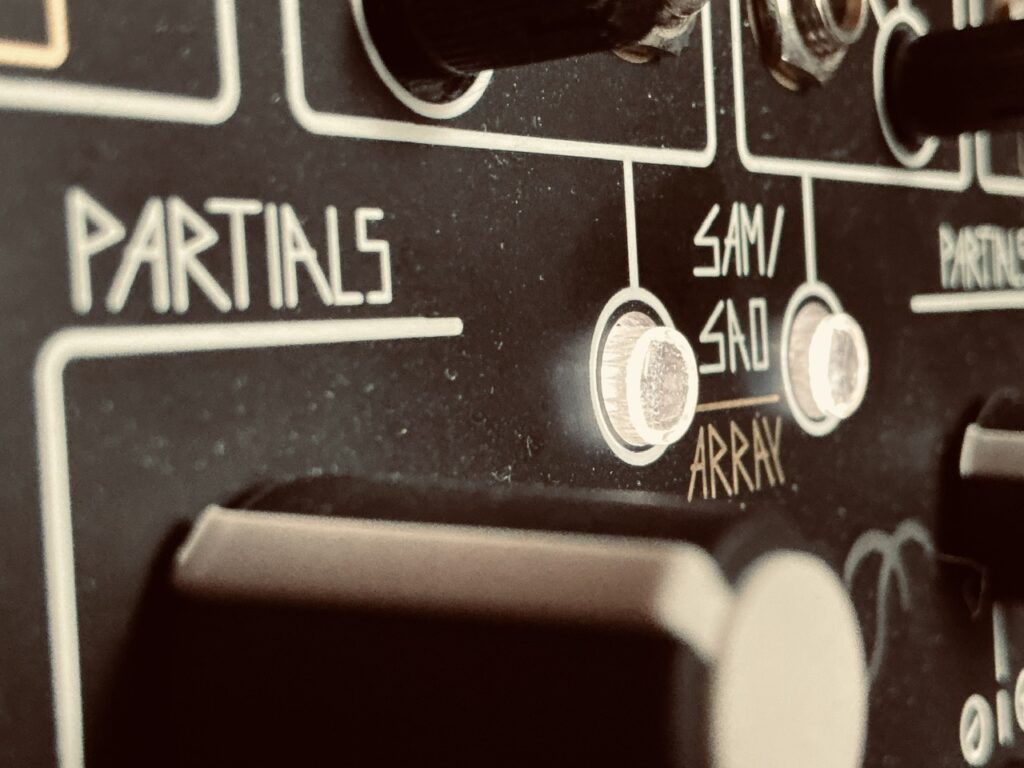
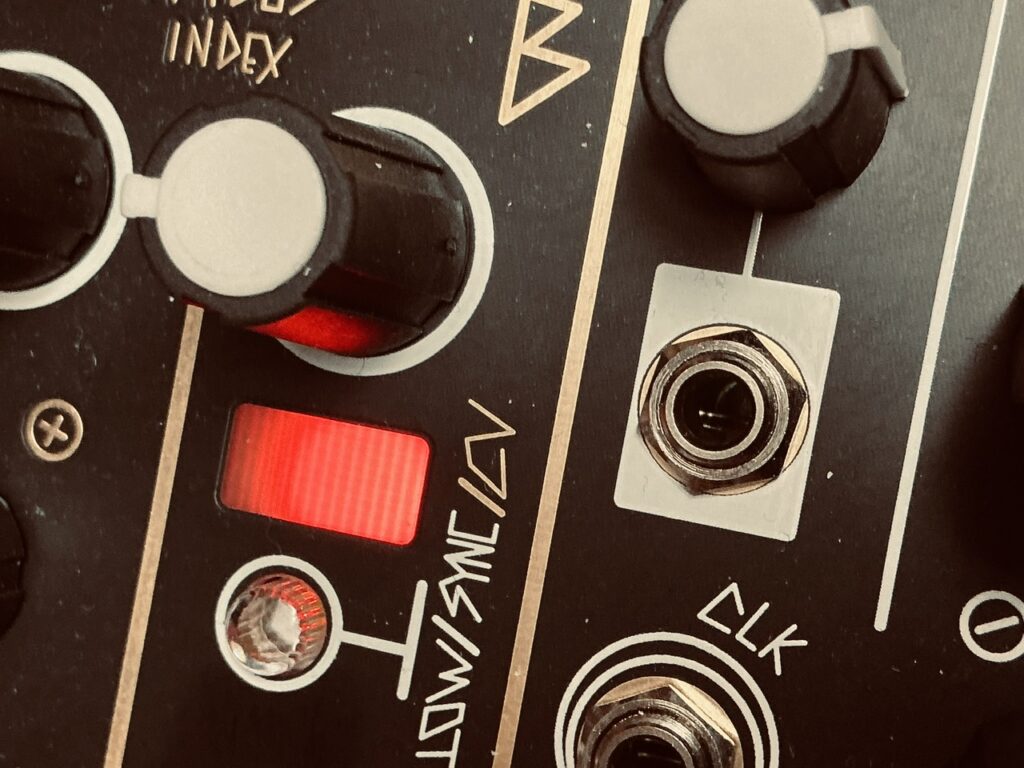
If you’ve read this site at all in the past you’ll know that I adore using very slow, free moving, unsynced waves to modulate the level of sounds in and out. To me it’s an incredibly inspiring sound that never gets tiring. These sorts of drones put me in a peaceful mindset quickly, and that’s something my soul can use of late. In the final track of the aforementioned Fields We Found album there’s one particular tone that is being modulated, either via frequency or amplitude modulation (I suspect it’s the former), and I wanted to try and replicate that sort of feeling, only throughout this patch.

Although I initially imagined Sketch 23 as a patch that would be predominantly be played within the NUSS, I ultimately decided to use a mixture of Spectraphon and DPO as the four oscillators that made up the bulk of the patch. Each oscillator was tuned to a different chord tone. Harmonically it’s a simple CMaj7 chord comprised of a C Major triad, C, E, and G, plus the major seventh B at the top. I know that when I imagined the patch I initially wanted to use a slightly more edgy C7 chord, but for some reason I just didn’t. At first I used the sine wave outputs from each oscillator, but later decided on adding some texture. For the two lower notes, C and E, I used the mixed outputs of each Spectraphon oscillator, though neither were modulated at all, both were set with a relatively low number of upper harmonics, and both had a smidge of FM as each oscillator modulated the other. The two upper notes of the chord, G and B, were sine waves from DPO, with Oscillator B FM-ing Oscillator A. All four outputs were patched to the first QXG, which received CV signals from Polimaths’ channels one, three, five, and seven.

One of the features that has me smitten on the Make Noise Polimaths is that it has a built-in ability to do amplitude modulation as a core part of an envelope. It’s a very unique sort of AM in that it contours with the function itself rather than separately acting upon the function or already modulated audio in a second VCA. And it was this feature, inspired by that one tone in “part five” of that Fields We Found album, that I wanted to not only use, but feature in this patch.

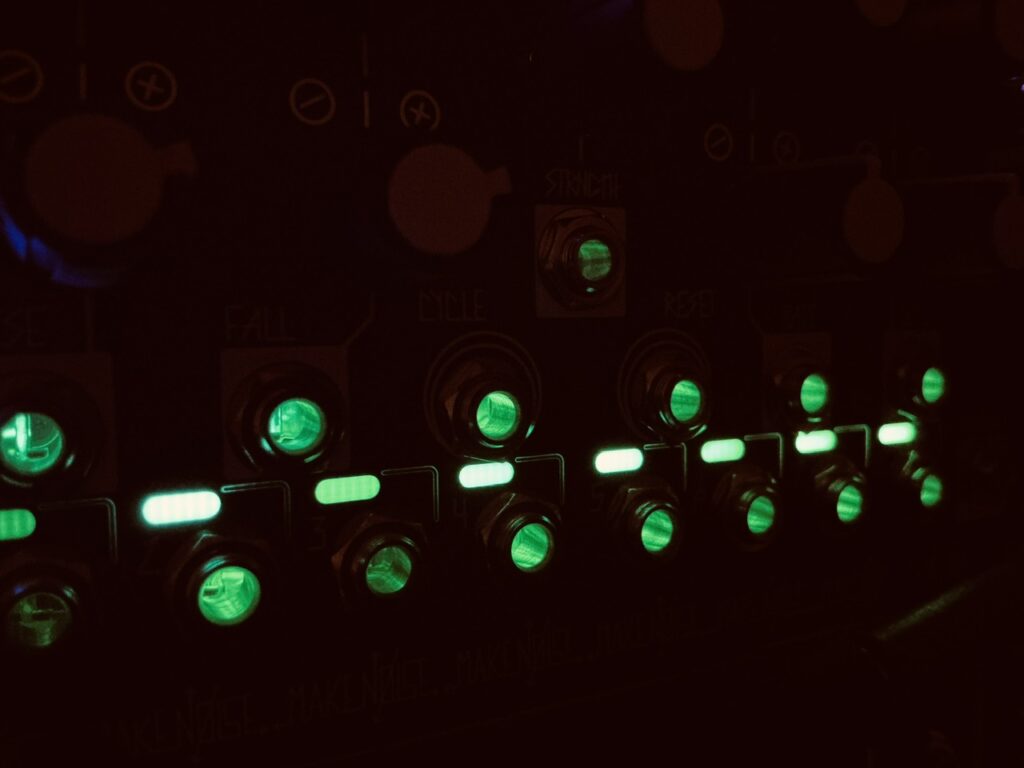
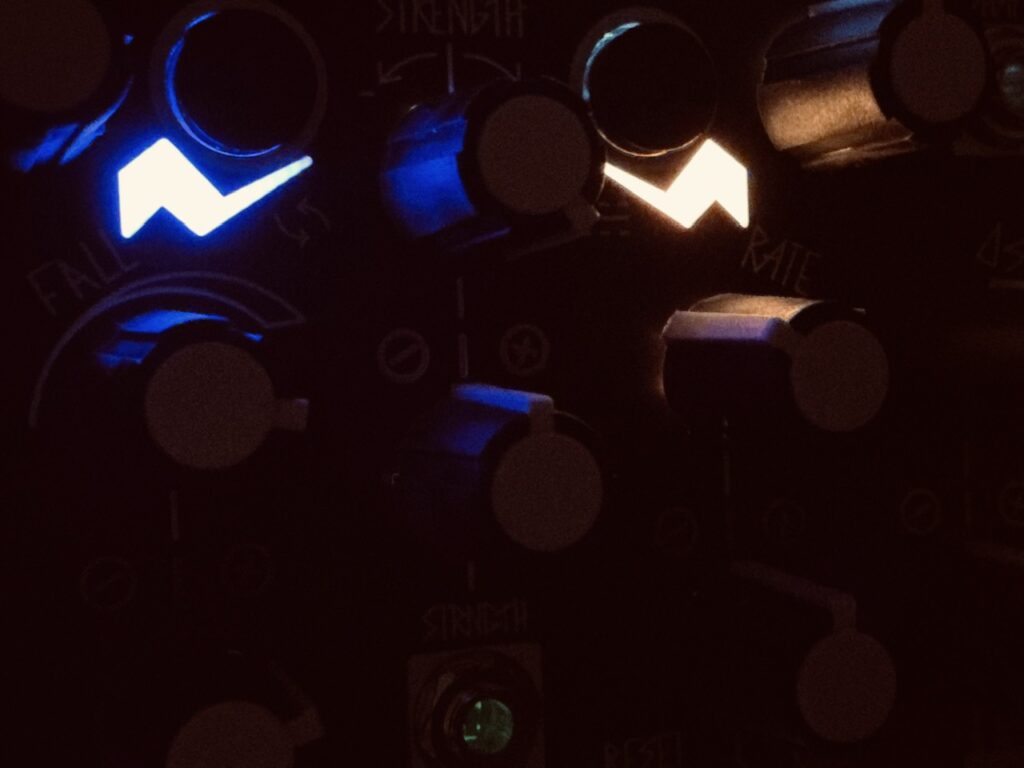
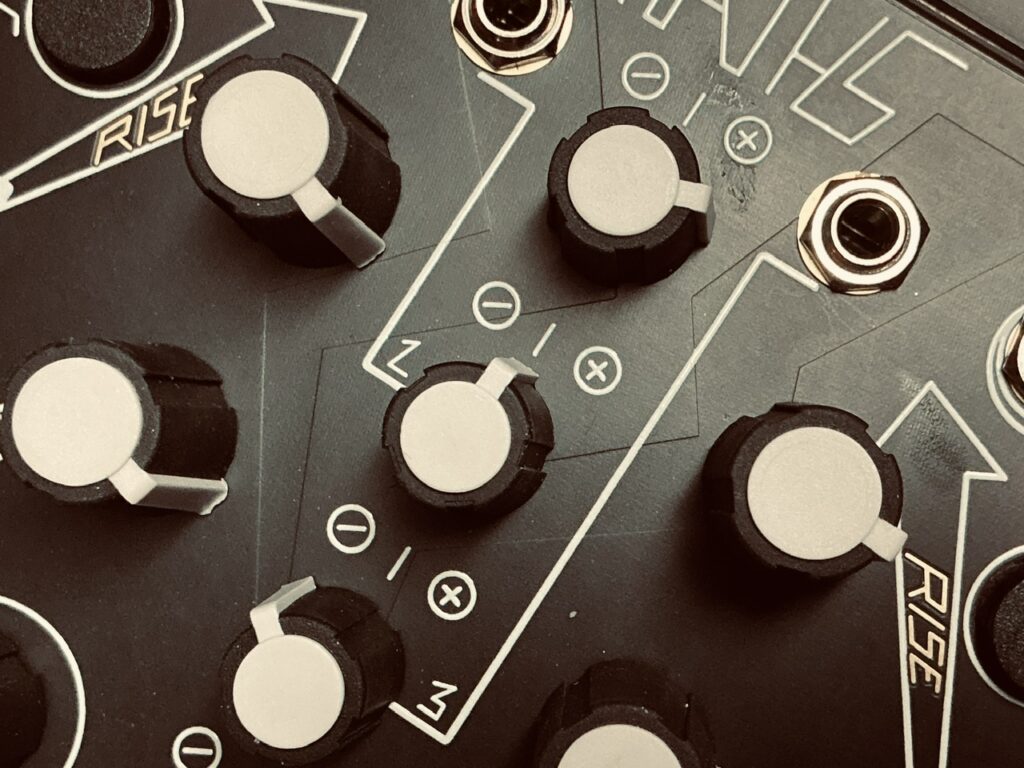
Polimaths is a wonderful module. Though not fit for every modular application, there are many for which it might not just be a good tool, but perhaps the best in all of Eurorack. It’s innovative in so many ways, and was built for polyphonic applications like this one. Even if you don’t pair it with Multiwave or use it with the rest of the NUSS it can find a place in any case. This patched started with already long rise and fall segments, only getting longer via its very excellent Spread Modulation scheme. In this patch lower pitches were controlled by longer envelopes, with higher pitches being progressively shorter. This helps form the pyramid shape of the parts for this piece. Lower, fatter sounds tended to be around longer, with notes becoming gradually shorter as the pitches move upwards. The oscillation amount and rate were equal for all four of the functions I used. Polimaths was set to both cycling and bipolar modes. I didn’t want constant sound. I wanted each chord tone to float in and out on its own terms, each fluttering about through the stereo field. One thing I’d probably change is that once the patch was recorded it seems like the oscillation amount was a bit too high. It doesn’t ruin or distract the listener, but I was going for a more subtle effect. It was more like a medium tremolo as opposed to a light fluttering of each note. It’s just not quite as delicate as I initially imagined, though still quite beautiful and compelling. In fact, it makes me want to learn how to patch these sorts of functions so that I might be able to use them in applications on Subsystems. These sorts of oscillating functions are ultra-cool, and useful in so many ways. All four functions were modulated in QXG such that they panned throughout tye stereo field throughout the piece. Each tone not only gently faded in and out, but also slowly danced from left to right and back again.
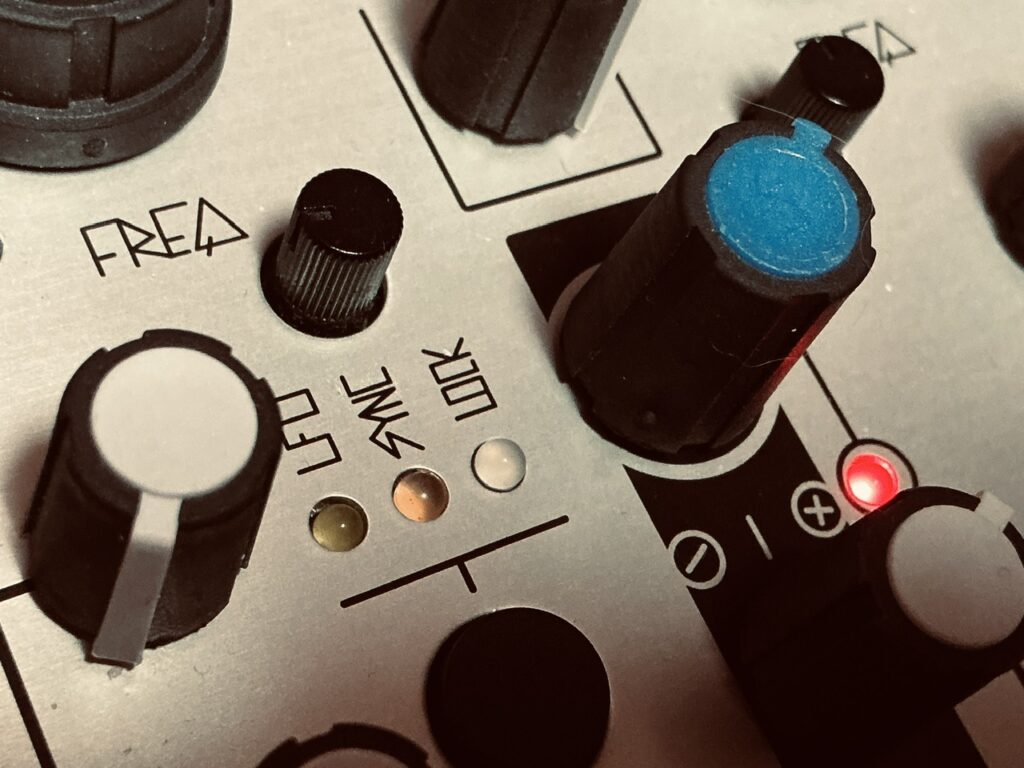
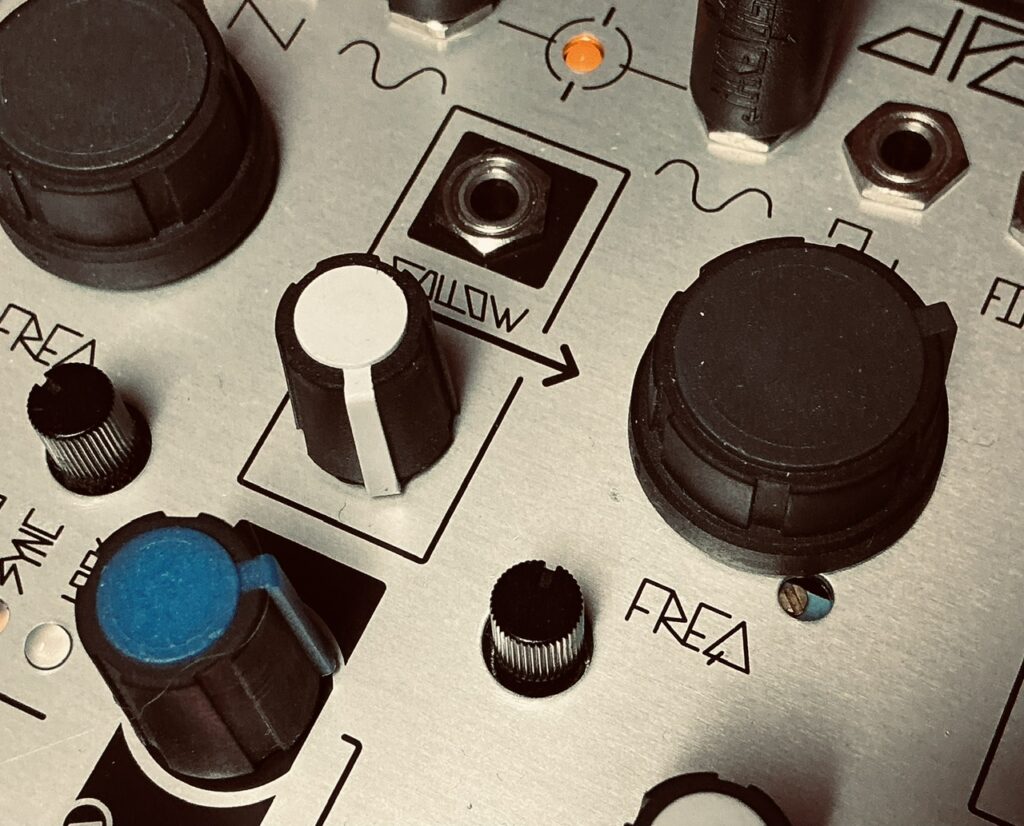
With the chords sufficiently flitting about the soundstage, it was time for ornamentation. The chord tones was the major point of the patch, but it was clear that something was missing. Although I tried several different ideas, none of them stuck. Either they were too dry or just didn’t fit. Then I remembered a passing scene in one of the original Echophon videos, and decided that was my path. I was going to finally figure out how to tame the beast. I have a funny relationship with Echophon. It’s definitely not a delay for every type of patch. It can be used like a standard lofi digital delay, but that buries the lede. Echophon isn’t a standard delay. It’s a pitch shifting maker of sonic wonders, but it definitely takes time to learn. And while Echophon is quite old, over a decade old at this point, I haven’t had one for very long, and I just haven’t really tried to flesh out its strong points. But that video gave me ideas, and I was bound to explore them.

Normally with delays I tend towards longer delay times. Most of the stuff I make moves rather slow, and much of my delay use isn’t to induce echoes or repeats, but as a means to stretch out and lengthen tones; a means to fill in space and make already long tones longer. But I quickly discovered that although Echophon can delay up to 1.7 seconds, that’s not where it really shines.1 Echophon has a signature sound. It’s pretty easily identifiable when you hear it. It’s covered up with digital aliasing. The mix knob is controlled by a vactrol so it’s never fully dry. Sometimes that sound is great, but when it comes to much longer pitch shifted tones that sound can become distracting. But with the right input, and the right delay time and feedback settings, those metallic tones from Echophon can sound like Candyland in all the best sorts of ways. A shimmering wonderland of bouncing partials that spirals upwards.

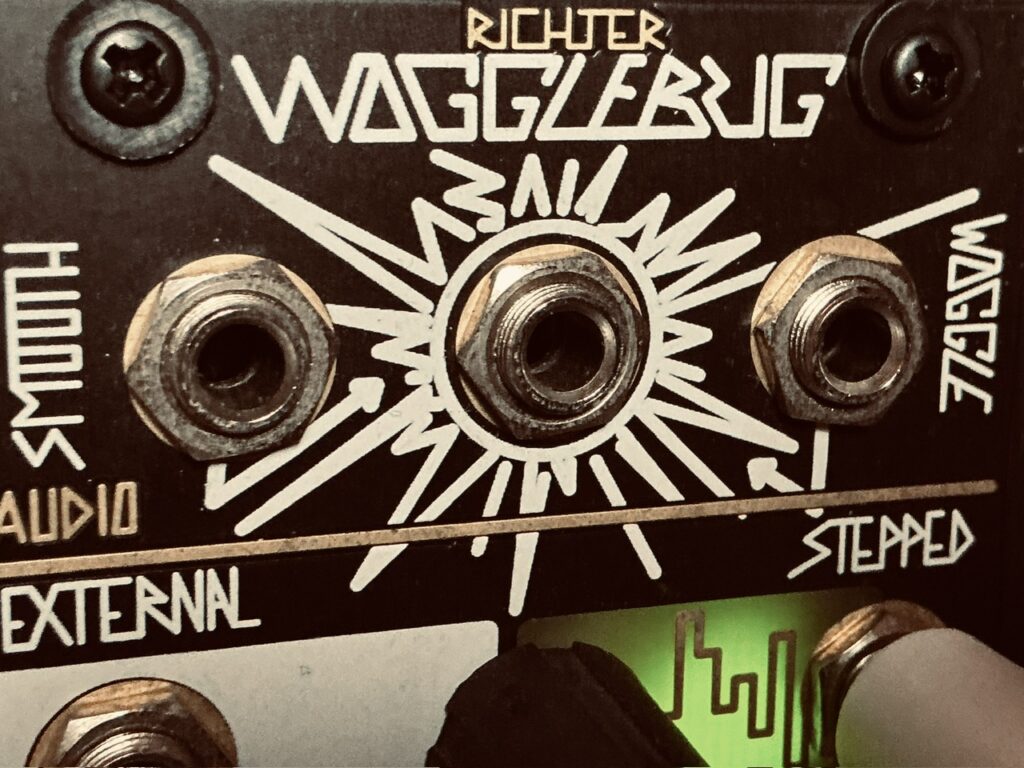
The input for this voice was simple. A sine wave from STO, enveloped by Contour via Optomix, sequenced by sending a negative offset and attenuated triangle function from Maths to the input on Wogglebug, while using its Burst output to quantize the Stepped output in René’s X Channel. These notes by themselves were a bit plain; plain sine waves with a snappy envelope. But once they went through Echophon’s pitch shifter and recycled through its feedback Loop 1, these tones turned into dancing sparkles that floated upwards and away like fireworks. It’s these sorts of tones that the Echophon excels at, and I’m glad to have finally discovered some of its secrets. The only modulation was a slow moving triangle function from Multimod to the Mix knob which was at about 50% attenuation, though I think it did go full wet. The mix of a delay isn’t something I’d normally modulate, but with this input, constant repeats got very busy, very quickly. Adjusting the mix was the best option I could come up with, which worked great, especially since, because of being controlled by a vactrol, even full CCW on the Mix knob is never fully dry. Normally this sort of vactrol bleed is undesirable, though I’ve learned to really lean into vactrol bleed in other contexts, but in this piece it worked out wonderfully. It wasn’t until this patch that I was able to coax out some of Echophon’s magic sauce, and I’m here for more.
All three parts, the bass from Spectraphon and QMMG through Bruxa, the fluttering chords from Polimaths, and the crystalline pings of STO and Echophon, were sent to Mimeophon with a fairly long delay time, and the Maneco Labs Otterley for reverb. The end of the piece, after the STO pings fluttered away for the last time, saw Otterley’s Reverb 2 make an appearance with its reverse granular delay at an octave up, which created a choir-like response that ended the piece perfectly.

Modules Used:
Polimaths
Spectraphon
DPO
QXG
QMMG
STO
Bruxa
Echophon
Mimeophon
Wogglebug
Contour
Optomix Rev2
René Mk2
Maths
Multimod
Channel Saver
modDemix
CV Bus Mk2
Maneco Labs Otterley

Outboard Gear Used:
Noisy Fruits Lab Lemon

Plugins Used:
Klevgrand Haaze 2
Klevgrand Luxe

Improvised and recorded in one take on iPad in AUM via the Expert Sleepers ES-9.

  1. There are likely many, many settings which use longer delay times to great effect. I, however, have not yet found them. ↩︎

Made Noise – Sketch 22 rev3

This patch is one of those patches that ended up very differently than it began. I suppose such is the life of many patches. Sometimes it’s because the electrons just aren’t flowing how you imagined, while others are borne from a drastic difference between the sound you heard in your head, and the one the synth is actually creating. Modular synth can be funny that way, and oftentimes the instrument guides you where it wants to go. It’s up to us to tame its moodiness and create something musical despite our initial intentions. Today was one of those days.

Initially I was looking for an unstable sound via Spectraphon’s Noise mode. Something wobbly and uncertain. And although I was able to find that instability, it just sounded…bad. Not “bad” bad in some objective (or even subjective) way, but kind of like when you go to take a huge gulp of Coke, only to discover too late that it’s Dr. Pepper in the cup. I was set on a particular sound, and when I thought I might have produced it, it was something wholly different. I can’t tell you how long I futzed with the patch to try and finally squeeze out the sound I was hoping for, but it was all to no avail. Fortunately Spectraphon with its four modes is ultra-flexible, and although it came as a result of a much longer process than just using and tweaking Spectraphon, I was finally able to find a nice, wobbly starting point from which to use as the base of the melody line while in standard SAO mode.

This patch begins with Tempi and René driving a very slow bass line, the progression of which was ripped directly from Alessandro Cortini’s piece, ERA, from Make Noise’s album Strega Music, showcasing the then new Strega standalone semi-modular synth and FX unit. Despite a deep back catalogue, ERA has always been one of my favorite Cortini pieces. The entire sequence is but four repeated notes, E1, F#1, G#1, and B1. It’s a deep and rich bass line; its major key giving off vibes of triumph. My first inclination was to keep the bass line a pure sine wave, but that was overtaken by my desire to instill some kind of evolution and movement to an otherwise short, repeated phrase, so I mixed in the Odd and Even outputs. Initially Partials, Slide, and Focus were only very lightly modulated to create subtle movement. Partials with a slow moving Smooth random output from Wogglebug(1), with Slide and Focus both being modulated by two separate Multimod outputs, which are Time and Spread adjusted copies of the Smooth random output of Wogglebug(2). I decided, however, to use a seldomly triggered oscillating function from Polimaths to Spectraphon’s Focus CV input, which resulted in some very compelling movement in the stereo field, while not actively serving as a distracting feature. Between us, this oscillating movement in the bass line, despite its sparseness as the patch progresses, is one of the most interesting parts of this recording.

The piece starts off with the bass line progression’s pure sine notes, but on the third repeat of tye sequence the Odd and Even outputs were slowly mixed in. The sine wave was enveloped by Contour, using gates from René’s Y-GT output to both trigger the envelope, and also to determine its Hold length before ending with a fairly long decay leading into the following note in the sequence. Although the piece starts with what appears to be a pretty heavy repeat of the note’s initial attack, something I still don’t particularly care for in the recording, once the Odd and Even outputs were introduced that rough jump smoothed out and was never evident again. The Sine wave was sent directly to the output mixer. The Odd and Even outputs, however, went through a slightly different process. In an attempt to keep this part of the bass line as subtle as I could while still allowing it to be dynamic and interesting, and as I’m wont to do in many of my patches, I patched the Odd and Even outputs to channels one and two of QMMG, and used a slow moving triangle function from Maths to modulate the cutoff frequency. This allowed the various partials, sometimes fluttering about in the stereo image, to remain subtle, never truly pushing any other voice to the sidelines, while still giving the bass line depth and a bit of complexity. Mixed together, the sine wave allowed the bass line to retain its heft in the middle of the stereo field, while the Odd and Even outputs widened the image a bit in a very compelling way to keep it interesting. Despite being a short four step sequence repeated over and over, it never really sounded the same on any given repeat of the sequence. It was always subtly changing.

The melody line was also borne of a familiar patching process. Tempi drove René’s X Channel in a five step on, five step off pattern using the Start/Stop parameter on the FUN page, while feeding Spectraphon’s Oscillator A v/oct input. The sine wave output was sent to QMMG. Its first stop was for some volume control in VCA mode. Perhaps it’s just a perception, but it seems to me that Spectraphon’s outputs run on the hot side. Even when I’m going straight to the mixer I often feel like I need to tame the signal first. But a hot output wasn’t the only reason I wanted to use a lower level into the filter. I was trying to induce wobble for instability in the melody line, and one of the key factors using a filter to get that wobble is that the sine wave’s level needs to be somewhat low. I discovered this technique accidentally a little over a year ago. Once I lowered the level by about 45%, the output was patched to another QMMG channel in Low Pass Filter mode, with moderately high resonance and a bipolar triangle function from Maths moving the cutoff frequency, though at a different rate than the function controlling the bass line. I really adore this technique of playing sequences using start and stop clocks with unsynced, slow moving signals moving the cutoff. It allows for surprises, while still remaining essentially pure. The 16 step sequence, between the five step start and stop clock that drove it along with the ever moving cutoff frequency which frequently goes low enough to hide notes, never repeats. The sequence itself never changes, but its manifestation is also never the same. Sometimes notes are brought in subtly. Other times they scream from the high, nonlinear resonance of QMMG. But even though the notes themselves never change, the melody line is always morphing. There s never a sense of repetition, but familiarity from Deja vu.

The filtered sine wave melody line was then patched from QMMG to Bruxa. Normally I would start off a performance with Bruxa running at a moderate input level somewhere around or just below unity level, and with the mix fully dry, before easing in more volume or a higher mix level (or both). But because the volume of the output was Spectraphon was lowered before being filtered in QMMG, I had Bruxa’s input level maxed from the start, and the slightly wet output from Bruxa was the finishing touch for the sort of wobbly unease I was seeking. In this patch, Bruxa was thoroughly modulated, using a Time and Spread shifted Smooth random outputs from Wogglebug(2) to both the Decay and Filter parameters, slowing moving those parameters around, while both of Bruxa’s CV outputs self-modulated Absorb and Time (the one with the attenuverter CV input). Modulating Time in this way, so long as the attenuverter is set very low, creates an almost flanger-like sound, which I find intoxicating.

I don’t think it’s a secret that I’ve come to adore Bruxa. In almost every patch it seems to add some missing ingredient or another that elevates the result. It’s become nearly a must-use in most of my Make Noise patches. It’s a master at adding grit and texture to anything you run through it; the answer to lots of questions. Need some noise? Bruxa. Need a wall of sound? Bruxa. Need to wash everything out? Bruxa. Need some subtle wobble? Bruxa. Though I won’t go so far as to say we need a stereo Bruxa, I would say that I wish there were one. But even though it seems unlikely that we’d ever get a stereo Bruxa, faking it can open up a wide array of possibilities.

Though there are many ways one might widen Bruxa’s output to form a stereo image right in the case, both QPAS and Mimeophon do great, I’ve come to using a plugin for this job. I’m not a huge fan of using plugins. I’m most definitely a hardware guy. I love my buttons and knobs. But sometimes a tool is so very useful and unobtrusive that not using it actively detracts from the final result. For me, that tool is the Klevgrand Haaze 2, a plugin designed to liven the stereo field using several different methods from the Haas Effect to mid-side processing. It works great for both mono and stereo sources, and opens up Bruxa’s mono output to fill the stereo field in a way that feels natural and complete. Haaze 2 has become a staple for me when using Bruxa. The difference is immediate and transformative.

The output from Bruxa wasn’t sent only to the output mixer, however. The signal was multed via the excessively useful CV Bus before being sent to Multimod(2) for some fun play with it as a delay. I originally bought a Multimod the day it was announced. In fact, I ordered it the second the video stated it was a modulation source. I had long thought that modulation sources was a weak spot for Make Noise. Sure, there is Maths, Function, Wogglebug, and others, but before Multimod, no matter the patch, I always seemed to run short on modulation. But by the time I watched Sara Belle Reed’s introductory Multimod video, which heavily showcased using Multimod as not only a CV source or a way to spread around modulation, but as a pitch shifting delay, I went and ordered a second Multimod specifically with the intent of using one to spread modulation about, and the other as an audio processor. Before I got a third 4-Zone CV Bus Case, I had this second Multimod in my effects section of the case. This isn’t the first time I’ve used Multimod as a delay. But it always surprises me when I do. The result is almost always much cooler than I expected, and is always full of surprises. This patch was no different. After experimenting with several different outputs, I ultimately chose outputs five and seven, which were Spread such that they were at 2x and 4x the input respectively, creating an echo at one octave up in the right channel, and two octaves up in the left channel, while the input, the melody line, played steadily through the center channel. These delays created a lot of movement as the piece progressed, and was a compelling way to accentuate the very slow melody line.

All three voices, the Spectraphon bass line, Bruxa infused melody, and the delayed outputs from Multimod(2) were all sent to Mimeophon for delay, as well as the Maneco Labs Otterley, via a high pass filter, for reverb. Everything was mixed before being processed by the Klevgrand Luxe plugin.

I won’t try and hide my excitement about this patch. I’m very taken aback by this one in a way I haven’t been in a long time. It’s quite beautiful, with a high sense of hope and maybe even triumph. It’s a feeling I need of late, and this patch and its recording has served as a sort of cathartic outlet for a lot of frustration and discontent in my personal life.

Modules Used:
Tempi
René Mk2
Spectraphon
QMMG
Bruxa
Mimeophon
Multimod
Optomix v2
Contour
Function
Maths
Wogglebug
Polimaths
Channel Saver
modDemix
CV Bus Mk2
Maneco Labs Otterley

Plugins Used:
Klevgrand Haaze 2
Klevgrand Luxe

Improvised and recorded in one take on iPad in AUM via the Expert Sleepers ES-9.

Jamuary 2631

Well, the last day of Jamuary has come, and even though I initially wanted a special send off patch for the final day, life just didn’t work out that way this year. See the theme for 2630 for more details.

This patch was a simple restructuring of 2629, substituting Echophon, with Bruxa in the feedback loop, as the main effect on the ring modulated melody line. I really enjoyed this patch and using 0-Ctrl as the primary sequencer for the melodic voice. For more detailed patch notes, see 2629.

Modules Added:
Echophon

Performed and recorded in 1 take in AUM on iPad via the Expert Sleepers ES-9.

Jamuary 2629

I had a goal when I walked up to the synth today: use at least two sub-patches that I haven’t used during this Jamuary. I knew one technique I was going to use off the bat. It had been a while since I did a “pinging QPAS” patch, and it was conducive to the mood I was in. The other manifested as I looked at modDemix. “Ring modulation! Of course!” To me this patch is almost a stereotypical Make Noise Patch™️. It’s the kind of sound that comes so very naturally from a Make Noise synth. The sort of patch that it was made to do.

This patch was made up of two basic parts. Tempi clocked both channels of René which sent out two trigger sequences from the X and Y channels to both inputs on QPAS, using the Low Pass outputs to create a stereo percussive beat. René was being modulated by two sample and hold signals in order to change the Snake of each channel and keep the trigger sequence from repeating itself. QPAS was highly modulated by Wogglebug’s Woggle VCO output, which is the first time I’ve ever use any of Wogglebug’s VCO outputs for any reason. I started this portion of the patch to serve as a percussive base. And although I think this part served that function admirably, it’s hard to describe many of the sounds produced by QPAS as something reminiscent of percussion. Maybe percussion stretched out like putty. Or a DJ scratching a turntable. The audio rate modulation from the Wogglebugs to both Radiate inputs fundamentally changed the sounds to something I very much enjoyed, though it’s quite hard to explain. The Burst outputs from both Wogglebugs also modulated the !!¡¡ inputs, while a fast moving Ramplet signal from Multimod modulated the cutoff frequency. Resonance was set high enough, about 10:30), for fairly lengthy tails on each ping, though, as with any ping from any filter, higher pitched notes were shorter than lower pitched notes. The result is more like the results of a loosely evolving drum circle with funky instrumentation where the only requirement was “stay in time” than a real groove of some type. It’s background noise to create a mood.

There is no real science to this part of the patch. It’s a bunch of triggers to the inputs, and a bunch of high frequency modulation being thrown at about every CV input except Resonance. But it’s also why using Make Noise is often special. One can get deep into the weeds with complicated patching techniques, patch programming, and circuitous routing of both control and program signals. But one need not do that in order to get good results that are fun and unique. Make Noise is one of those modular environments that really takes modulation well. As with anything one can go overboard and really muck a patch up, but generally speaking Make Noise modules tend to take high levels of modulation gracefully.

The second voice in this patch was made up of two sine waves from Spectraphon ring modulating each other at a 1:1 frequency ratio (I.e., they were tuned to the same note) in modDemix. Spectraphon was sequenced by 0-Ctrl, with one of its gates reversing direction. Although it’s useful in many respects, I don’t use modDemix very often for any “important” role. I’ll sometimes use it as a simple mixer and a simple VCA with a unipolar envelope or gate, but most often I’ve used it as a simple level attenuator for a too hot signal. Though I do have times when I’ve used it as a ring modulator, those times are few and far between. It’s just not really a sound I use that much (and when I do it’s almost always in a context very close to this patch). But today ring modulation was the point, and I really dig the result. Improvising the gating of the sequence was a kind of fun I don’t normally have when using the modular. It was lots of knob-twisty goodness. That said I had hoped that the short decay envelope from 0-Ctrl would have been shorter. I’m not sure whether it was because of being externally clocked or whether there was an actuator problem, but there just didn’t seem much difference between using the Dynamic Gate and the Dynamic Envelope outputs (which signifies my lack of understanding the Strength Control(s) and how it related to the Speed control, and thus the longer-than-desired envelopes being an actuator issue). These Dynamic Envelope hit a LPG in QMMG. From QMMG, the signal was patched to Bruxa for some light echo and texture. Bruxa, once again, provided a bit of magic to the sound. The ring modulated tones were great on their own, which is why I never overdid the wet/dry mix on Bruxa in this patch, but the bit of added echo and noise to the ring modulated sequence was special.

Modules Used:
Tempi
René Mk2
QPAS
0-Ctrl
Spectraphon
Wogglebug
QMMG
modDemix
Bruxa
Mimeophon
Maths
Multimod
CV Bus Mk2
Maneco Labs Otterley

Performed and recorded in 1 take in AUM on iPad via the Expert Sleepers ES-9.


Jamuary 2627

I’ll admit that I was pretty hyped about 2626. It’s not a sound I typically create, and sometimes a change of pace is what’s needed to gather perspective. In that light, when I walked up to the synth for 2627 I knew I wanted to continue down that path and further explore this sequence with different patch routings and effects. Yesterday I used Mimeophon for both the melodic sequence and the bass line. Mimeophon was a logical choice, it’s a crazy good stereo delay, but I had other ideas I wanted to try. Other textures I wanted to explore. Although I’ve been heavily invested in using Bruxa of late, particularly during this Jamuary where I’ve used it several times, I wasn’t yet ready to delve into un-clocked texture creation. I still wanted a delay that’s controllable, or at least clockable. Echophon was calling my name.

Other than being a certified delay junkie, I’m not sure what drew me towards Echophon. It was discontinued years before I was involved in Eurorack, is only mono (input and output), and it has a very opinionated sound. This isn’t your everyday digital delay with clean repeats. It is an unabashedly lofi pitch shifting digital repeater with an external feedback loop, and sound signature that, if you know it, is unmistakable. It can be harsh. Notes alias with regularity. It’s quirky, weird, and it can be unruly. And in that space it’s perfect.

The core of this patch is the same as 2626. Tempi clocked René, which sent out pitch and gate sequences for a highly modulated Spectraphon arpeggiated line, and a multi-output mix of oscillators from Spectraphon and DPO through a QMMG for bass. And despite the bass line still using Mimeophon (primarily as a means to thicken the sound up), the melody line was patched to a clocked Echophon. Pitch shifting was set to what I’m pretty sure is a fifth above the input pitch. Initially I wanted to this patch with no delay before introducing some of the wet signal. But because Echophon uses a vactrol to control the wet/dry mix, the wet signal is never fully closed off. Having a shadow of the delayed signal, however, was an interesting effect in itself, and so chose to lean into a bit at the beginning. As the recording progressed, I added modulation from Wogglebug’s Stepped output, which also acted as a control signal on several facets of the patch, to Feedback. Not long after I also added a clock-divided gate from Tempi to toggle the Freeze function, which repeated the buffer while the gate was high. This is also when I introduced the feedback loop to and from a heavily modulated QPAS and completely transformed the output.

Although I enjoyed using Echophon for this patch, something led it awry. Whether it was too much modulation, Freezing too often (or at all), or the feedback loop, there was something disjointed between the dry signal and the affected signal. They didn’t always seem to go hand-in-hand. The dry signal sounded dry, and the wet signal didn’t always resemble what went in. Upon listening back multiple times, I think it’s the Freeze that is pulling the output away from the input. It seems to repeat a small section too often and for too long without allowing itself time to breathe in between Freezes.

Modules Used:
Tempi
René Mk2
Spectraphon
DPO
QMMG
Wogglebug
Channel Saver
Multimod
Echophon
QPAS
Mimeophon
CV Bus Mk2

Performed and recorded in 1 take in AUM on iPad via the Expert Sleepers ES-9.

Jamuary 2622

The entire approach to today’s Jamuary patch was to amend a couple of things from 2621, while adding in an effect on top. I had improvements I felt would make the patch better, and after having contemplated those changes for much of the day, I wa eager to make it happen.

This patch is not different at its core. I made no changes to Polimaths and its many functions. I did, however, change Multiwave slightly. I felt like 2621 was really nice, but parts got in a frequency range that can get tiresome after a bit. It wasn’t wholly egregious in its transgressions, but enough that I felt like lowering the pitch on Multiwave would help substantially. But having lowered the base pitch of Oscillator B, I also needed to adjust Oscillator A’s pitch upward slightly, as well as its attenuation for Spread Modulation, because its function in providing subharmonic frequencies now was too low to be useful. And since I had lowered the base pitch, I felt like I could raise the number of octaves produced by René. I wanted to make other adjustments in the sequencer to avoid grating dissonance as much as possible, which I did by relegating any notes not in the Cmin triad to the top octave. That adjustment worked quite well, allowing both the 7 as well as the 11 to be added to the randomly generated sequence without running into dissonance. But by solving one problem I created another. I found what I thought was a better base tuning for Multiwave, and I still think it was a better tuning, but rather than eliminating or cutting down substantially in higher frequency pitches, adding an octave to the sequence created even more of them, and at even higher frequencies, than in 2621, despite only using two of the 16 steps in that third octave. For some reason the distribution of random voltages that controlled René seemed to constantly land on those higher pitches more often than I would have desired.

Another change I made that I’m not sure made a positive difference, was to slow down Wogglebug’s clock. In 2621 the modulated clock often became noticeably faster than the NUSS could keep up with. This occasionally resulted in notes suddenly changing mid-envelope, and likely contributed towards ugly dissonance because of the sheer number of pitches sent out. Changing the sequence so that off-pitches only occurred in the top octave likely did more to alleviate the ugly dissonances, but I’m certain slowing the clock likely also helped in that regard. However, the change also came at a cost. Part of what made 2621 beautiful was its fullness. There were lots of notes happening in short time spans, making it sound thick and dense. Slowing the clock thinned out the overall soundstage noticeably, though not detrimentally. It’s still a beautiful chord floating around, but there just isn’t as much of it.

The last substantial change I made was to run the entire mix through the Chase Bliss Audio Generation Loss Mk2. I wanted a more lofi feel for this patch, and Gen Loss provided lofi in spades. The model was set to 5, Portamax-HT, described in the manual as “Desktop-style, all-in-one 4-track recorder, played back at half-speed.” Wow and Flutter were set fairly low, and although I raised them slightly as I played the patch, they never reached about 10 o’clock. Saturation was also set low at the start, though raised more substantially to around noon as the patch progressed. The Noise level was set to heavy, and the Dry sound set to Unity. Failure was set low, below nine o’clock, though I sporadically hit the Aux switch to produce the occasional garbling that is heard through the piece. It’s not a sound I want all the time, but it’s a good one.

I still want to improve this patch. It has a lot of great potential. Some changes for today worked better than others, but those missteps also act as a guide for what I need to alter in the next iteration.

Outboard Gear Used:
Chase Bliss Audio Generation Loss Mk2

Performed and recorded in 1 take in AUM on iPad via the Expert Sleepers ES-9.

Jamuary 2621

When I finished 2620 I was left wanting for more. Although it wasn’t a complete disaster, it certainly didn’t materialize how I’d hoped. It was a frustrating effort trying to get the two parts to match, and in the end I couldn’t do it, especially not with midnight looming. Although once I finished recording I walked away from the synth, it wasn’t very long, perhaps 45 minutes or an hour, before I walked right back to the synth to start something new. It was a new day, after all, and though one patch didn’t work out, Jamuary still moves forward. I briefly considered working the patch, which was still playing away, how I’d initially envisioned, but abandoned that idea pretty quickly. One particular patch I really enjoyed making was 2619, and I wanted to see how else I might use similar techniques in order to broaden my experience with the NUSS.

One thing that had confounded me over the last couple of days was trying to align individual Activations of the NUSS, driven by CV and not triggers or gates to the Actvation input, with individual pitch changes. When using a Maths function to control the NUSS, the best I could muster was exactly one pulse per cycle (I could have two separate pulses using Function, however, as it has both an End Of Rise gate as well as an End Of Cycle gate), but I wanted something different; a new pitch with every activation. But I couldn’t figure out how to patch that. Polimaths doesn’t have some form of gate or trigger output. I was stuck. Not wanting to simply repeat a patch I did the night before, I soon went in a different, though related direction, and figured out a couple of solutions to my problem.

The patch started with a Speed-modulated Wogglebug. The Smooth output was patch programmed to the Speed CV input, which created a non-stable tempo in an almost chaotic fashion. But rather than using the outputs to only control the NUSS, I multed the stepped output to René first, and used it to change step locations in the X Channel. Each new voltage moved to a random step in the quantized sequence (Cmin Pentatonic – though as is often the case, I don’t know where the oscillator was tuned). Because the speed was being modified, there was no real time. Just a flow of voltages moving out at different speeds. This worked out fantastically, and led to two breakthroughs. Firstly, I could trigger an Activation by using the X Gate output. Every time the random signal moved the sequencer to a different step, a gate would fire and Activate the NUSS. And although this technique worked out okay, I had to use one of the sequential modes, like Robin, which moves each Activation predictably. I didn’t want that sort of predictability, so I tried something different by using the same random voltage that controlled René to Polimaths’ Span input while in Channel Index mode, thus allowing the signal to change just the same as in René. When Wogglebug produced a new random voltage, both René and the NUSS would move to a random position. René advanced to some other step on the 16 note grid sending a new pitch, while the NUSS would Activate one of its eight channels randomly. This is exactly the sort of behavior I was after, and it’s one that will very likely work well when used with a Maths (or Function) function.

My initial intention was to use Wogglebug’s Smooth output as the main source of control for this patch, and I will definitely try that soon, but I felt that using the Stepped output would produce a more readily apparent voice. What I didn’t want to do was futz with attenuation as I got deep into the patch to ensure that René and the NUSS were moving in concert. I didn’t want Renē to advance while the NUSS didn’t, nor vice versa. I’m sure it’s all very possible, but it would have required getting just the right level of attenuation for both control destinations. In any case, however, I wasn’t eager to make a switch because I very much enjoyed what was happening in the moment.

My initial instinct was to create short plucks as each new note was Activated, like it was with 2619, but it was a bit weird. I’m sure I could massage out a better outcome than I had at the time, but I quickly discovered that using this sort of patch as a moving drone of sorts was what my soul really needed. I need to fix the quantization scale a bit so that I run into fewer dissonances, but overall this is the sort of patch I’ve been trying to figure out with my Make Noise synth for a long time. The NUSS makes it a joy. All together, this eight voice patch with heavy modulation throughout only used 24 patch cables. Of course at least 16 patch cables have been eliminated by the Buss cables connecting Polimaths and Multiwave to QXG, but the onboard modulation also saves various other cable connections from needing to be patched in order to be thoroughly modulated in interesting ways.

With the core of the patch made, it was on to the particulars of the NUSS. Polimaths was set to fairly long envelopes, with the shape set somewhere between linear and exponential, though definitely closer to exponential. The Rise and Fall of each envelope, along with the Strength, Rate, and Osc, were all modulated using Spread Modulation, with higher numbered channels being slightly longer, with slightly stronger, and faster, oscillations, while each envelope was also slightly louder on the whole. But because the channels were Activated at random, there wasn’t a set pattern like there would be in Robin mode using triggers from René. Subsequent channels were often triggered at similar levels, but just as often were triggered at very different levels. These levels differences between chord tones really created depth within the sound stage.

Like 2619, the modulation for Multiwave in this patch was all quite simple. A slow moving triangle wave from Multimod controlled the Balance of Oscillators A and B. The Follow mode for Oscillator A on Multiwave was set to Green (Integer Multiply), with each oscillator progressively having a lower subharmonic accompanying the fundamental pitch, both sides slowly revealed, hidden, and revealed again as the Balance was slowly shifted back and forth. Multimod also slowly modulated the Xpread on QXP to keep the channels constantly moving in the stereo field. Not only were some notes closer or further than others, creating depth, but they were constantly shifting back and forth. The Wave for each oscillator, both from the Red (Classic Shapes) Bank, was modulated by Multiwave’s internal Multimod using the Sine shape on one oscillator and the triangle shape on the other. The Pitch knob of Oscillator A was modulated via Spread Modulation, each channel having a lower harmonic than the last as the channel number increased. With a fairly high note used to set Oscillator B’s pitch, having several subharmonics wasn’t a huge problem. The Waves for each channel, and the (Modulation) Time, were also modulated with the onboard Spread Modulation, each channel moving just a little slower than the last through the wavetable.

As the patch progressed and was nearing the end, I added in a gate to Multiwave’s Accumulation input, which created randomly generated chords. I’m not sure how much it added. Much of the time, the channels were already in use when the Accumulation gate would finally release the saved pitches, and so chord generation became instant, rather than with gradual rise and fall. It doesn’t sound bad, and you probably have to listen closely to hear it, but it is there.1 I haven’t used the Accumulation feature much. I’d like to use it more deliberately, but I haven’t yet found a good way to serially address chords without just throwing a bunch of notes at Multiwave. I need to learn how to sequence chords in a way that makes sense to me.

The mix went straight from QXG’s outputs to the output mixer where it was sent to both Mimeophon for delay and Otterley for reverb.

The result was a fog where chord tones swirled about each other, slowly fading in and moving about, before just as sneakily fading back away into the ether from whence it came. This patch is the sort of thing I could listen to all day, and indeed I’ve had it on repeat since I hit stop on the recording.

I tried to set up an accompanying voice to this chord cloud, but I couldn’t find a good sound to go along with it. My initial thought was a set of pings, but my attempt at it when it was nearing three AM was half-hearted and ended predictably.

Modules Used:
Wogglebug
René Mk2
Multiwave
Polimaths
QXG
Multimod
CV Bus Mk2
Mimeophon
Tempi
Maneco Labs Otterley

Plugins Used:
Klevgrand Luxe

Performed and recorded in 1 take in AUM on iPad via the Expert Sleepers ES-9.

  1. As a note, an instant pitch change happens occasionally through the generation of the individual notes as well, as sometimes the random values generated correspond to a channel that has not yet finished its previous note. ↩︎

Jamuary 2618

I’m late with posting this patch, so there won’t be much exposition.

Back to simple sequencing. Two staggered sequences, one 5 steps and the other seven steps, go to XPO and Spectraphon respectfully. I like these sorts of patches a lot. They’re needn’t be a technically difficult patch, though one can get as technical as one might desire. XPO is in the lead role, coming from modulated stereo PWM outputs, and through a modulated QPAS. Spectraphon plays the bass part via Oscillator B’s Sub output (a saturated sine), through a modulated QMMG in LP mode, and then through Bruxa for that extra special treatment.

The resonance on both filters is reasonably high, 11-12 o’clock on the knob, leading to some wicked saturation. Growls are common, and I might have even heard some wobble, particularly in the bass part. A Function function modulated QPAS’ cutoff frequency simultaneously with the heavily attenuated Right HP output. QMMG was frequency modulated by a slow moving Maths function.

Both parts go through Mimeophon and Otterley for delay and reverb.

Modules Used:
Tempi
René Mk2
XPO
Spectraphon
QPAS
QMMG
Maths
Function
Wogglebug
Polimaths
Mimeophon
CV Bus Mk2
Maneco Labs Otterley

Performed and recorded in 1 take in AUM on iPad via the Expert Sleepers ES-9.

Jamuary 2617

I was very enamored with yesterday’s patch. It was a beautiful way to use the full NUSS for the first time. And because of that I wanted to do a variation on a theme. The core of the NUSS is very similar. I altered couple of knobs, and changed some of the modulation, though primarily in direction and degree, not type. But I decided earlier today that I wanted to run as much of the patch as possible from a single Wogglebug. Rather than using the End Of Cycle trigger an ever-changing Maths function to establish a wonky clock, I decided to use the Burst output as the trigger for René’s sample and hold mode, and the Woggle output as the CV from which pitches were derived. Rather than using the Stepped output to Activate Polimaths (and Multiwave), I chose the Smooth output.

One peculiarity about this way of moving the NUSS along in this particular way was that the Smooth voltage moved faster than the Burst output, so as the different channels were Activated, they were often the same pitch as the prior channel’s Activation. Pitches moved along, but not as efficiently as with the Maths method where each Activation was at the same time as each pitch change, using the Stepped output. And because it was a slow moving Smooth voltage, the Activations tended to cluster around three or four channels. While every channel was occasionally Activated, the signal tended to hang out in sections.

Despite some of these peculiarities, the patch still turned out beautifully. The pitches were in Dmin Pentatonic (D F G A C). As the piece progressed I raised the attenuation on the incoming sample and hold voltage to increase the range upwards.

After yesterday’s Degrader debacle, during which there simply wasn’t enough level in the final recording, I decided to have another go at it. This time it worked great. I hope.

Performed and recorded in 1 take in AUM on iPad via the Expert Sleepers ES-9.

Jamuary 2616

One thing I hadn’t done before I walked up to the synth for 2616 was to use the full NUSS. I’ve used the core of the NUSS, Multiwave, Polimaths, and a pair of QXGs, and I’ve made a couple of patches that add in a Multimod (or two), but I’ve never used all of the NUSS modules in one patch. I’m looking at you, Jumbler.

Part switch, part crossfader, and part mixer, Jumbler is a bit of a weird module. Even when it was introduced shortly before Superbooth it was a bit of an oddity. Not because it wasn’t utilitarian, but because, unlike Multimod, introduced just a few weeks before Jumbler, it only had six inputs and six outputs. The reveal of Polimaths at Superbooth shortly thereafter, which, like Multimod, is an eight output device, highlighted the discrepancy of Jumbler even more. Even early on it seemed like the red-headed stepchild of the group. Don’t get me wrong; I ordered Jumbler pretty much immediately after being announced, but even then I wasn’t exactly sure how I might integrate it into my patches. And even despite a couple of early videos from Make Noise, I was still left questioning its use case. Though I tend to use a goodly amount of modulation in most of my patches, I’m not a “throw as much modulation around a patch as possible” type of guy. I use modulation for enhancement, often quite subtlety, not as a gaudy display of a synth hurling electricity about wantonly. But I still wanted to figure out a way in. A way to use Jumbler in a manner I thought tasteful despite its apparent mismatch with the rest of the NUSS.

I knew when I approached my synth that today was going to be a full NUSS day. A patch that used all five of the NUSS modules at the core. Like the last couple of patches during this Jamuary it started with a Fall-modulated Maths to produce a wonky clock. The End Of Cycle output of Channel four was patched to Wogglebug’s clock input, and each new trigger produced a random voltage that changed its fall length, as well as several other parameters throughout the patch, and creating a randomly generated clock. Though the last couple of patches used that wonky clock to drive one of René’s sequencer channels, I used this one slightly differently. Rather than advancing a preset sequence, I used René’s Sample and Hold feature in order to quantize Wogglebug’s random voltage output into my desired scale so that all of the notes would remain in key. With every EOC trigger from Maths, Wogglebug sent a random voltage to René’s X CV input, which was quantized to the nearest note in the scale (a variation on C minor Pentatonic – C Eb F G A) and sent to Multiwave, though I don’t know what note Multiwave was tuned to. The result is a constantly shifting cloud of chords that weave different tones in and out. That same random voltage from Wogglebug was also patched to the Span input on Polimaths which Activated its functions one through eight randomly. At its heart, this patch was a modified Krell of sorts, where all of the pitches, note articulations, and note lengths were randomly generated, though like many generative-type patches, every action stayed within mostly defined parameters. Notes were a particular set of pitches, each one with preset boundaries of length and volume. Within those boundaries the system is free to do as its wont to do unless I change those limits, but it should never stray outside without explicit permission.

My theme for today was slow(ish) and large. The Rise and Fall of Polimaths was set reasonably high, with Rise receiving the same random voltage as René and Polimaths’ Span input, so that every function it created was as long or longer than the knob on the face. Each activation received a new length. Because the length and pitch voltages were from the same source, it roughly correlated to a “higher notes are also longer notes” paradigm. Each note rose slowly, though with a more exponential shape, that Rise is more like “slow then quick.” Fall was modulated via Spread Modulation, with envelopes closer to output one being longer than those of output eight. Strength was modulated similarly, as well as both Rate and Osc.

In Channel Index mode, Multiwave followed along. As Polimaths was Activated by the random voltages from Wogglebug, Multiwave was too, though indirectly. Having experimented with and really enjoyed the Purple (Additive) wavetable bank (waves two and four for Oscillators A and B respectively) the last couple of patches, I chose to stay with those in this one, with various parameters modulated. The Blend between the two oscillators was modulated by a bipolar triangle function from Multimod (or maybe Maths), while Wave, while Glide was modulated by the attenuated Smooth output from Wogglebug. A-Wave, B-Wave, A-Pitch, and Mod Time were modulated using a moderate amount of Spread Modulation. This ensured that each of the eight channels has a sufficiently different timbre from the others at a given time. Modulating A-Pitch (set in Green – Integer Multiply – mode) this way is particularly fun. Each oscillator has a progressively higher harmonic to accompany it, coloring the piece in fanciful ways. So far, this is my favorite setting for Oscillator A’s Follow setting (although octaves also sounds nice).

To put it simply, this patch had an array of modulation affecting it, though all of it progressively, and very slowly. The outputs of the QXGs, both pan-modulated by two slow triangle functions from Multimod, were then patched to QPAS. Although three of the four modulatable parameters on QPAS were being modulated, it was all quite slowly and not very heavily. The cutoff frequency was lightly modulated with a triangle function. A mix of the Smooth and Woggle outputs from a second Wogglebug, along with one cycling triangle function, were mixed in Maths, along with some negative offset, moving both Radiate L and Radiate R with the Sum and OR outputs respectively. All of the modulation was heavily attenuated. I wanted a bit of movement as opposed to a swirling soup. And this is where the patch got interesting.

Normally I would use a single set of QPAS’ outputs in a given patch. In this one I decided to use three sets, LP, BP, and HP. Each was patched to the six inputs on Jumbler, while using only outputs three and four. Two slow moving sine waves from Multimod were used to modulate both Radiate and Rotate so that there would be continuously changing outputs that morphed between the six inputs. It took a while to massage the CV for Radiate and Rotate to make sure that at least one of the outputs was always active, but once dialed in it was fantastic. Each of the outputs mixed and swirled with the others, along with having some time to be more prominent. This mode of mixing audio was interesting and beautiful, and I’ll definitely be trying something like it again.

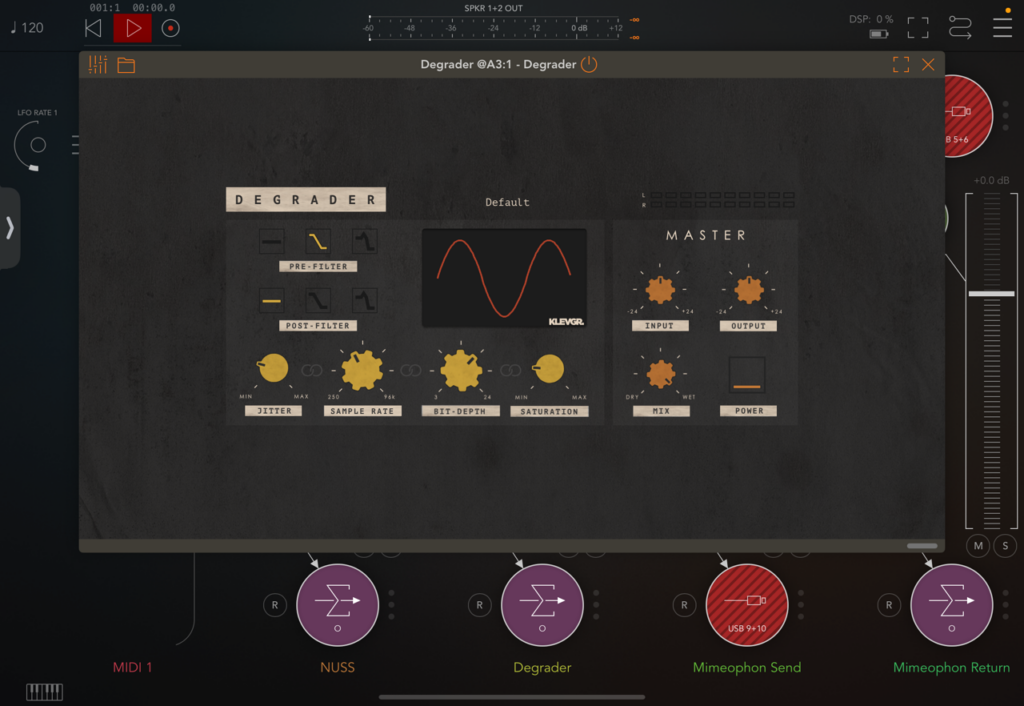
The two outputs from Jumbler were sent to the mixer before being treated to a rare plugin. Although my recent patch with sample reduction worked okay, that itch wasn’t really satisfied. The Wogglebug out was just too dirty for my tastes. Not only was the audio reduced, but it was seemingly decimated too. It couldn’t even follow the pitches of the audio it was being fed. So I decided to alleviate my desire for some tasteful downsampling by using the very excellent plugin, Degrader, by Klevgrand. I have several of Klevgrand’s plugins. Not only are they inexpensive on the iPad, they’re fantastic. Degrader is a simple plugin. You can downsample and/or bitcrush audio, along with adding saturation and jitter. I used a MIDI LFO plugin to modulate the sample rate, while keeping the audio at eight bit, and added a smidge of saturation to make it pop. However, my headphones fooled me. While I performed the piece during the recording I thought Degrader’s level was fine. But when listening back (and by looking at the waveform) I quickly discovered it just wasn’t loud enough. A small amount of static can be heard, but we didn’t get any of that Nyquist goodness to come through for the vast majority of the piece.

The Jumbled output was also sent to Mimeophon for delay and Otterley for reverb, along with the barely audible output from Degrader.

Another plugin I used, the Klevgrand Luxe, is one I’m just starting to experiment with. I don’t use many plugins, but it seems that this particular role in my workflow, compression and saturation on the stereo bus, is best relegated to a plugin rather than trying to use a complicated hardware setup. It’s a simple plugin, with but 1 control. A simple slider to set the amount of the effect you want on the audio. The plugin itself does the heavy lifting of setting compression and saturation amounts. I’m generally skeptical of these sorts of plugins, but this one seems to do a pretty good job at enhancing the audio in some fashion. Time will tell, however, if it’s something I stick with.

Modules Used:
Maths
Wogglebug
René Mk2
Polimaths
Multiwave
QXG
QPAS
Jumbler
Multimod
Channel Saver
Mimeophon
CV Bus Mk2
Maneco Labs Otterley

Plugins Used:
Klevgrand Degrader
Klevgrand Luxe

Outboard Gear Used:
Noisy Fruits Lab Lemon

Performed and recorded in 1 take in AUM on iPad via the Expert Sleepers ES-9.

0:00
0:00